By Sunita Poudel, certified sound healer, Kathmandu · Reviewed by Sunita Poudel on 4 November 2026 · Last updated 4 November 2026
An aura is described in many spiritual traditions as a subtle field of energy or light that surrounds the body and reflects a person’s state of being. It is part of the wider idea of a subtle body, an inner layer of energy beyond the physical body. Science has not detected auras, but the idea remains a meaningful map in meditation and energy practice.
Key takeaways
- The aura is pictured as a field of energy surrounding the body, while the subtle body is the inner energy system that includes the chakras.
- Yoga describes three bodies and five layers, or koshas; Tibetan Buddhism describes channels, winds and drops.
- Science has not measured an aura. Some researchers think people who “see” auras may experience synaesthesia.
- You can work with the idea through attention, breath and sound, without needing to believe anything fixed.
I am Sunita Poudel, a certified sound healer in Kathmandu, Nepal. My second certification, in 2018, extended my training from the seven chakras to the 12-chakra framework, which looks beyond the physical body. In this guide I explain what the aura and the subtle body mean in tradition, what science does and does not say, and how you can explore them gently.

What is an aura?
An aura is a field of subtle energy or light that, according to many spiritual traditions, surrounds every living being. It is usually pictured as an oval glow around the body, extending a short distance from the skin, and said to change with a person’s mood, health and state of mind.
The idea appears in many cultures. Religious art often shows a halo or glow around saints, buddhas and deities. In modern energy practice, the aura is often described as having layers and colours, with each colour said to reflect a quality such as calm, energy or creativity.
What is the subtle body?
The subtle body is the idea, found in Hindu and Buddhist traditions, that alongside the physical body each person has an inner body of energy, made of channels, centres and life force. The chakras are part of this subtle body. The aura is often described as its outer expression, the part of our energy that extends beyond the skin.
Different traditions describe the subtle body in different ways:
- Three bodies in yoga and Vedanta: the physical body (sthula sharira), the subtle body (sukshma sharira) and the causal body (karana sharira).
- Five layers, or koshas: from the physical outer layer, through layers of breath, mind and wisdom, to the innermost layer of bliss.
- Channels and energy in yoga: prana, the life force, is said to flow through channels called nadis and to gather at the chakras.
- Tibetan Buddhism: the subtle body is described through channels, winds and drops, used in advanced meditation practice.
To understand where the chakras fit within this, start with my guide to the 7 chakras, or read the overview of chakras from Encyclopaedia Britannica.
How are the aura and the chakras connected?
In energy traditions, the chakras are seen as centres inside the subtle body, and the aura as the field that surrounds and reflects them. Some practitioners describe the aura as having layers that correspond to the chakras, and believe that a calm, balanced state inside is reflected in a clear, even aura outside.
The 12-chakra framework I trained in adds energy points above the head and below the feet, which links the inner chakras with the space around the body. You can explore it in our 12-chakra system section.
Is the aura real? What science says
Science has not found evidence that auras exist as a physical field of energy, and there is no reliable instrument that measures them. It is important to be honest about this.
Some researchers have explored why certain people report seeing auras. A study from Spanish universities compared people who described seeing auras with people who have synaesthesia, a condition in which the senses blend, for example seeing colours when looking at faces or hearing sounds. The researchers suggested that some reports of auras may be explained by synaesthesia (Milán et al., 2012).
My honest view: the aura is best understood as a spiritual and meditative idea, not a measured fact. Like the chakras, it can still be a helpful way to bring attention to how we feel, and to notice how our state affects the people and spaces around us.
From Sunita’s practice
My training gave me two maps: the seven chakras within the body, and the 12-chakra framework that reaches beyond it. I also hold Reiki Level 1, which grounded my practice in energy awareness. I use these maps as tradition, to guide which bowls I play and how I pace a session, and I share them with clients in the same way: as a helpful map, not a scientific claim.
What do aura colours mean?
In popular energy practice, aura colours are said to reflect mood or personality, but these meanings vary widely and have no scientific basis. A common modern pattern links aura colours with the chakra colours: red with grounding and energy, orange with creativity, yellow with confidence, green with compassion, blue with expression, indigo with intuition, and violet or white with spirituality. Treat these as a reflection prompt rather than a diagnosis.
How can you sense your own energy?
You do not need special abilities to explore your own energy. Simple attention practices help you notice the body and the space around it. Try this 5-minute practice:
- Sit comfortably and close your eyes. Take five slow breaths.
- Rub your palms together for 20 seconds, then hold them a few centimetres apart. Notice any warmth, tingling or pressure between them.
- Slowly move your hands apart and back together. Notice how the sensation changes.
- Bring your attention to the space just around your body, as if you could feel a soft layer surrounding you.
- Breathe slowly into that space for a minute, then open your eyes.
The warmth you feel between your hands has simple physical causes, such as body heat and blood flow, and it is still a lovely way to bring your attention into the body. To deepen this kind of awareness, try pranayama breathing, a guided meditation, or learn about what Reiki is.
How is sound used with the subtle body?
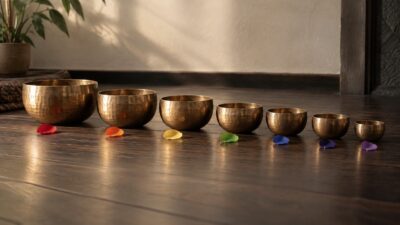
In sound healing, singing bowls are traditionally matched with the chakras and played around the body to bring attention to each energy centre and to the space around it. For an introduction, read what sound healing is. Practitioners often use a matched set of bowls, one for each chakra. If you are not sure where to begin, the Singing Bowl Chakra Quiz suggests a starting point.
A note on wellbeing
Energy practices can support relaxation and self-awareness, but they do not diagnose or treat any condition. Be cautious of anyone who claims to diagnose illness from your aura. If you have health concerns, please see a qualified professional. See our health disclaimer.
Frequently asked questions
What is an aura?
An aura is described in many spiritual traditions as a field of subtle energy or light that surrounds the body and reflects a person’s state of being. It is a spiritual idea and has not been detected by science.
What is the subtle body?
The subtle body is the idea, found in Hindu and Buddhist traditions, that each person has an inner body of energy alongside the physical body, made of channels, energy centres such as the chakras, and life force, or prana.
Can people see auras?
Some people say they see colours around others. Researchers have suggested that some of these experiences may be explained by synaesthesia, a condition in which the senses blend. There is no scientific evidence that auras exist as a physical field.
What is the difference between the aura and the chakras?
In energy traditions, the chakras are energy centres inside the subtle body, arranged along the spine. The aura is described as the field of energy that surrounds the whole body and is said to reflect the chakras.
What do aura colours mean?
In popular practice, aura colours are said to reflect mood or qualities, often following the chakra colours, such as green for compassion and blue for expression. These meanings vary and have no scientific basis.
About the author
Sunita Poudel is a certified sound healer in Kathmandu, Nepal. She holds Advanced Sound Healing & Therapy (Golden Temple Singing Bowl & Healing Center, 2017), Advanced Sound Healing, 12 Chakra (Mandala Studio Yoga & Spa, 2018) and Reiki Level 1 (Empowered Academy, 2020) certifications, and has led more than 1,500 sessions.
Sunita co-founded Dharma Tool and selects every instrument it sells. Read her full story →
Sources
- Milán EG, Iborra O, Hochel M, et al. Auras in mysticism and synaesthesia: a comparison. Consciousness and Cognition, 2012. University of Málaga research portal.
- Chakra. Encyclopaedia Britannica.
This article is for general education and does not replace medical advice. See our health disclaimer.