By Sunita Poudel, certified sound healer, Kathmandu · Reviewed by Sunita Poudel on 30 October 2026 · Last updated 30 October 2026
The 7 chakras are energy centres described in Hindu and Buddhist yogic traditions, arranged along the spine from its base to the top of the head: root, sacral, solar plexus, heart, throat, third eye and crown. Each is traditionally linked with an area of life, from feeling grounded to feeling connected, and is used as a focus in meditation, yoga and sound healing.
Key takeaways
- “Chakra” is a Sanskrit word meaning wheel. The seven main chakras run from the base of the spine to the crown.
- Each chakra is linked with a theme, such as safety, creativity, confidence, love, expression, insight and awareness.
- Chakras are a traditional and spiritual map, not a part of anatomy that science has measured.
- You can begin working with them through simple attention, breath, movement and sound.
I am Sunita Poudel, a certified sound healer in Kathmandu, Nepal. The seven chakra system is the foundation of my training, from my first certification in Patan in 2017. In this guide I explain the seven chakras as simply as I can: where each one sits, what it represents, and how a beginner can start working with them.

What are chakras?
Chakras are centres of subtle energy that, according to yogic tradition, sit along the centre of the body and connect the physical and the inner, emotional life. The word “chakra” means wheel or circle in Sanskrit, because each centre is pictured as a spinning wheel or a lotus flower.
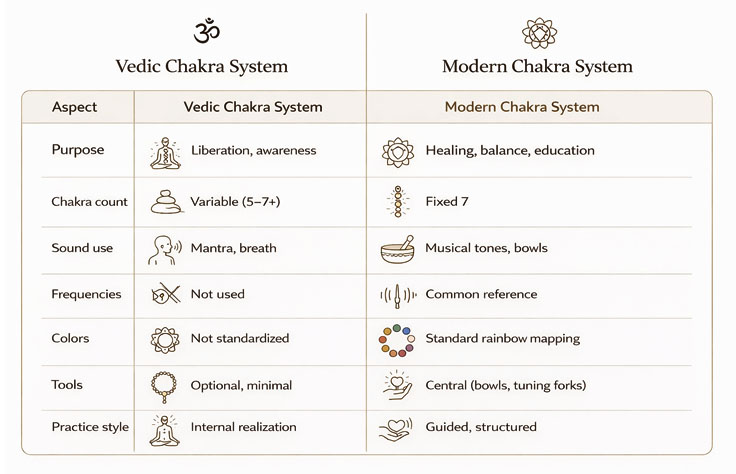
The idea comes from the meditative practices of certain Hindu and Tantric Buddhist traditions. Some texts describe thousands of chakras, but seven are considered the most important, arranged roughly along the spine (Encyclopaedia Britannica). The seven-chakra system most people learn today is the one that became widespread in yoga and wellness practice.
It is important to be honest: chakras are a traditional and spiritual map. They have not been found or measured by science. Many people still find them a useful way to bring attention to the body and the mind, and that is how I use them.
What are the 7 chakras?
From bottom to top, the 7 chakras are the root, sacral, solar plexus, heart, throat, third eye and crown chakras.
| # | Chakra | Sanskrit name | Location | Traditional theme | Colour |
|---|---|---|---|---|---|
| 1 | Root | Muladhara | Base of the spine | Grounding, safety, stability | Red |
| 2 | Sacral | Svadhisthana | Lower abdomen | Creativity, emotion, pleasure | Orange |
| 3 | Solar plexus | Manipura | Upper abdomen | Confidence, willpower, energy | Yellow |
| 4 | Heart | Anahata | Centre of the chest | Love, compassion, connection | Green |
| 5 | Throat | Vishuddha | Throat | Communication, expression, truth | Blue |
| 6 | Third eye | Ajna | Between the eyebrows | Intuition, insight, clarity | Indigo |
| 7 | Crown | Sahasrara | Top of the head | Awareness, spirituality, unity | Violet or white |
The rainbow colours are the most common modern convention. Older texts describe the chakras differently, and traditions vary.
What does each chakra represent?
Each chakra is traditionally linked with one part of human experience, moving from basic security at the base of the spine to awareness and connection at the crown.
1. Root chakra (Muladhara)
The root chakra sits at the base of the spine and represents feeling grounded, safe and supported. It is often linked with our basic needs: home, health and stability.
2. Sacral chakra (Svadhisthana)
The sacral chakra sits in the lower abdomen and represents creativity, emotion, pleasure and the ability to go with the flow of life.
3. Solar plexus chakra (Manipura)
The solar plexus chakra sits in the upper abdomen and represents confidence, willpower and personal energy, the inner fire that helps us act.
4. Heart chakra (Anahata)
The heart chakra sits at the centre of the chest and represents love, compassion and connection, both with others and with ourselves. It is often seen as the bridge between the lower and upper chakras.
5. Throat chakra (Vishuddha)
The throat chakra represents communication and self-expression: speaking honestly and listening well.
6. Third eye chakra (Ajna)
The third eye chakra sits between the eyebrows and represents intuition, insight and clear thinking.
7. Crown chakra (Sahasrara)
The crown chakra sits at the top of the head and represents awareness, spirituality and a sense of connection with something larger than ourselves.
From Sunita’s practice
In the handwritten notebook from my training in Patan, each of the seven chakras has its own page, with its note, mantra and mudra. In my sessions I use this map to choose which bowls to play, and I play the chakras in two directions: from root to crown for therapy, and from crown to root for healing. These are the methods I was taught, and I share them as tradition.
Are there more than 7 chakras?
Yes. Some traditions describe many more chakras, and some modern systems use 9 or 12. The seven-chakra system is the most widely taught and the best place to start. I also trained in the 12-chakra framework in 2018, which adds energy points beyond the body. You can explore it in our 12-chakra system section.
How can beginners work with the 7 chakras?
The simplest way to begin is a short practice that moves your attention slowly up through each chakra, from the base of the spine to the top of the head. Try this 7-minute chakra awareness practice:
- Sit comfortably with a straight, relaxed spine. Close your eyes and take three slow breaths.
- Bring your attention to the base of your spine (root). Breathe into this area for about one minute and notice how it feels.
- Move your attention to the lower abdomen (sacral), then the upper abdomen (solar plexus), for about one minute each.
- Move to the centre of the chest (heart), then the throat, for about one minute each.
- Move to the point between your eyebrows (third eye), then the top of your head (crown).
- Rest for a moment with your awareness on your whole body, then open your eyes.
You can deepen this practice with movement in our chakra yoga guides, or with gentle routines in chakra balancing practice.
How is sound used with the chakras?
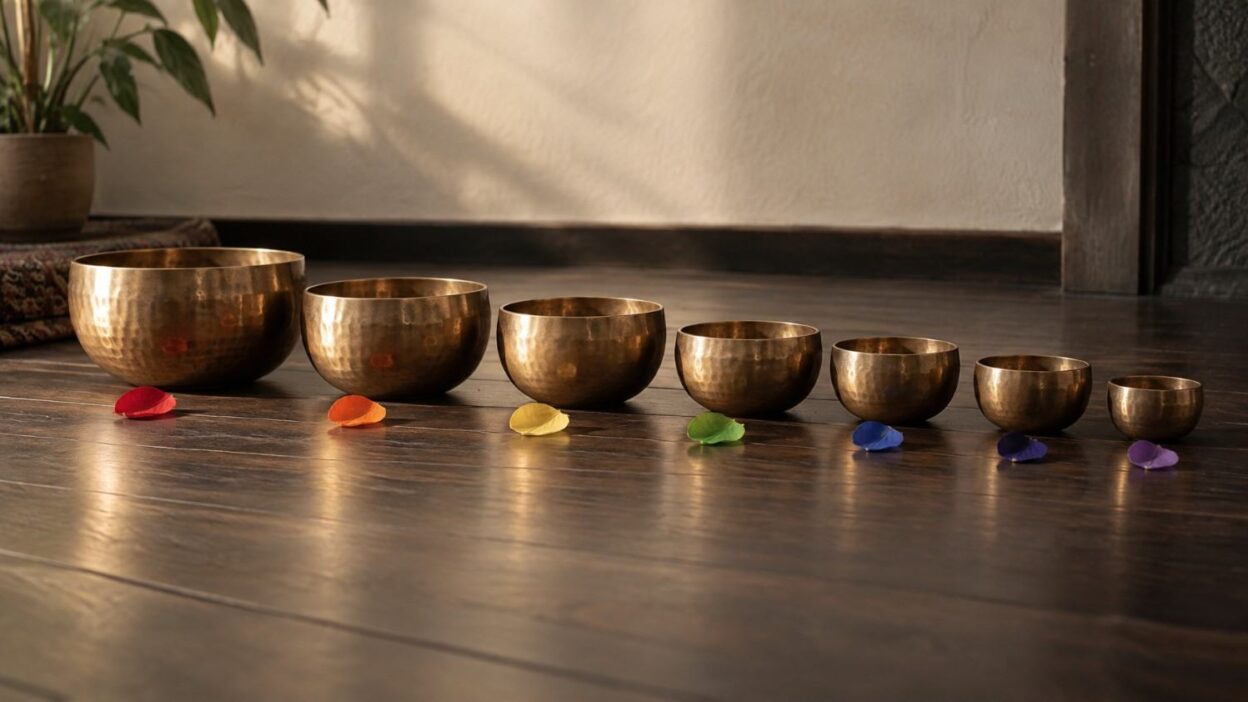
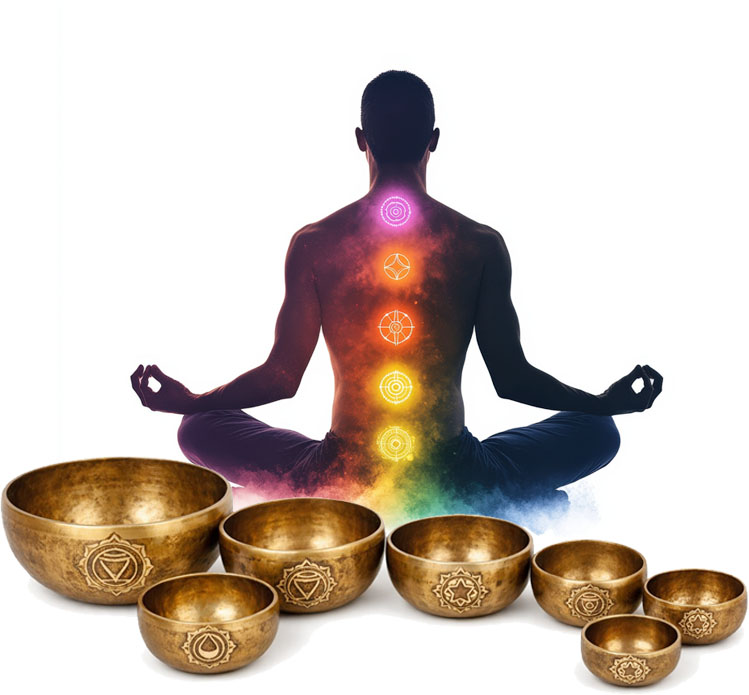
In sound healing, each chakra is traditionally paired with a musical note, so a set of singing bowls can be played from the root to the crown. This gives the chakra practice above a sound to follow. If sound practice is new to you, start with what sound healing is.
Dharma Tool explains which note is linked to each chakra, and how a balanced seven-bowl set is put together. Chakra bowls come in singing bowl sets of 3, 5, 7, 9 or 12, so you can start small.
A note on chakras and health
Chakra practices can support relaxation, self-awareness and a sense of balance. They do not diagnose or treat any medical or mental health condition. If you notice ongoing physical symptoms or emotional difficulty, please see a qualified professional. See our health disclaimer.
Frequently asked questions
What are the 7 chakras in order?
From the base of the spine upwards, the 7 chakras are the root (Muladhara), sacral (Svadhisthana), solar plexus (Manipura), heart (Anahata), throat (Vishuddha), third eye (Ajna) and crown (Sahasrara).
What does chakra mean?
Chakra is a Sanskrit word meaning wheel or circle. Each chakra is pictured as a spinning wheel or lotus of energy along the centre of the body.
Are chakras real?
Chakras are part of traditional and spiritual systems from Hindu and Buddhist yoga. They have not been found or measured by science, but many people find them a helpful map for meditation and self-awareness.
Which chakra should a beginner start with?
Most teachers suggest starting with the root chakra, because it represents grounding and stability, and then moving upwards one chakra at a time.
What colours are the 7 chakras?
In the most common modern system, the chakras follow the rainbow: red (root), orange (sacral), yellow (solar plexus), green (heart), blue (throat), indigo (third eye) and violet or white (crown).
About the author
Sunita Poudel is a certified sound healer in Kathmandu, Nepal. She holds Advanced Sound Healing & Therapy (Golden Temple Singing Bowl & Healing Center, 2017), Advanced Sound Healing, 12 Chakra (Mandala Studio Yoga & Spa, 2018) and Reiki Level 1 (Empowered Academy, 2020) certifications, and has led more than 1,500 sessions.
Sunita co-founded Dharma Tool and selects every instrument it sells. Read her full story →
Sources
- Chakra. Encyclopaedia Britannica.
This article is for general education and does not replace medical advice. See our health disclaimer.