By Sunita Poudel, certified sound healer, Kathmandu · Reviewed by Sunita Poudel on 15 October 2026 · Last updated 15 October 2026
A full moon ritual is a short, intentional practice done on or near the full moon to pause, reflect on the past month and let go of what no longer serves you. A simple version takes 20 minutes: settle the space, reflect in writing, release with sound or breath, and close with quiet gratitude.
Key takeaways
- When: on the night of the full moon, or a day either side. Early evening works best.
- How long: about 20 minutes.
- Four steps: settle, reflect, release, give thanks.
- Tools: none required. A notebook helps; a singing bowl is a lovely extra.
I am Sunita Poudel, a certified sound healer in Kathmandu, Nepal. In Nepal, the full moon day, called Purnima, has always been a time to pause, pray and reflect. In this guide I share a simple full moon ritual you can do at home, wherever you live, in about 20 minutes, with or without any special tools.
What is a full moon ritual?
A full moon ritual is a simple, repeated practice that uses the full moon as a monthly reminder to stop, look back and consciously let go. It is not a spell or a ceremony you have to get right. Think of it as a monthly appointment with yourself, timed by the moon instead of a calendar.
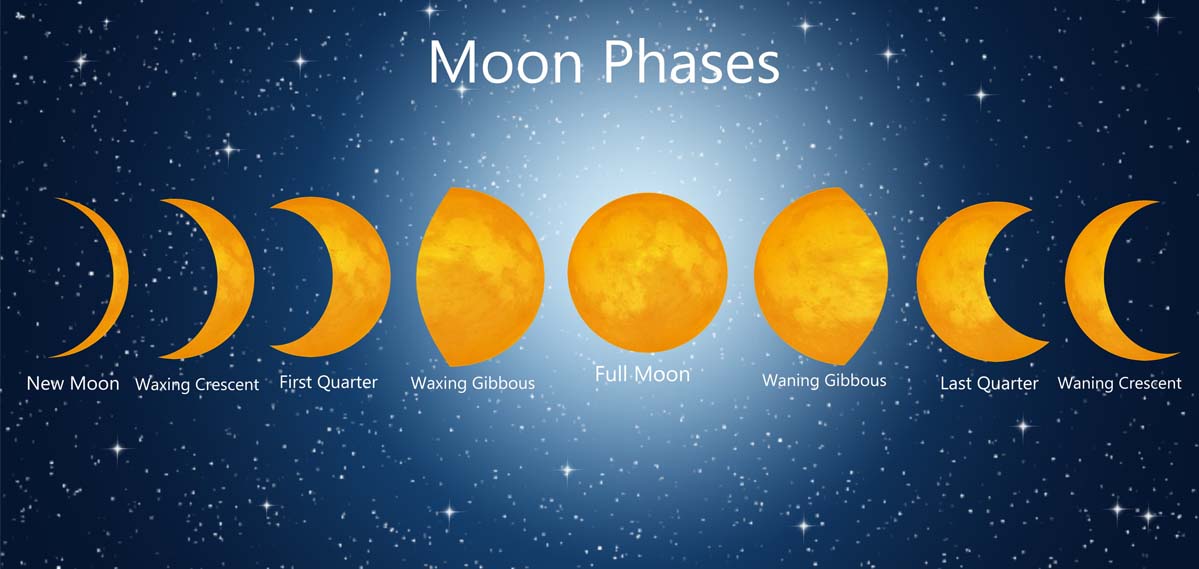
Because the full moon comes back roughly every 29.5 days, it gives you a natural rhythm. Over a year, those twelve short evenings become a record of how you have changed.
Why do people mark the full moon?
Across many traditions, the full moon has long been treated as a time of completion, clarity and spiritual practice. In Nepal, Purnima is observed in both Hindu and Buddhist life. Several important festivals fall on full moon days, including Buddha Purnima, which marks the birth, enlightenment and passing of the Buddha. In Buddhist tradition, the full moon and new moon are also days of observance, when many people keep extra precepts, meditate and visit monasteries.
These are traditions, not scientific claims. You do not need to follow any religion to use the full moon as a moment to reflect. You can read more about Nepal’s festivals in our festivals and blessings section.
When is the best time to do a full moon ritual?
The best time is the evening of the full moon, or the evening before or after it. The moon looks almost full for about three nights, so there is no need to wait for an exact minute.
Choose the early evening rather than late at night. A 2021 study found that people tended to go to bed later and sleep less on the nights leading up to a full moon (University of Washington, 2021). Finishing your ritual early helps protect your rest. For gentle bedtime practices, see our sleep guides.
How do you prepare your space?
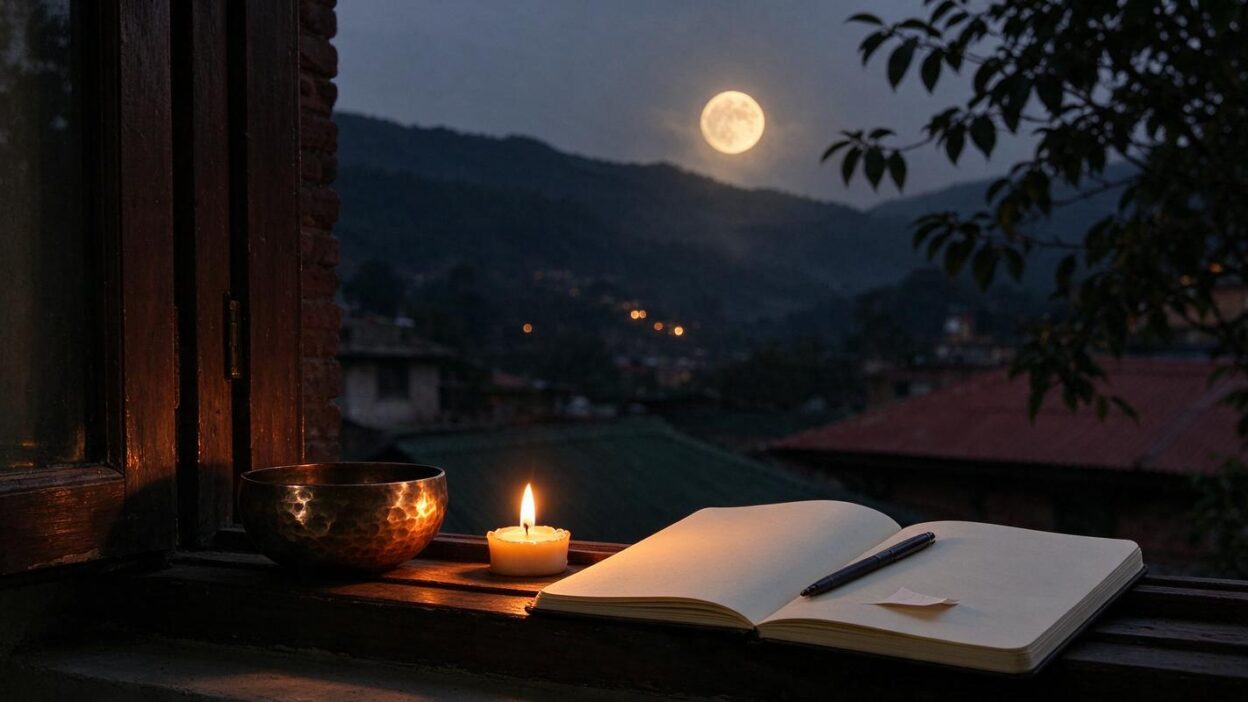
Choose a quiet corner, dim the lights, and remove distractions for 20 minutes. Put your phone on silent and out of reach. A candle, a cushion and a notebook are enough. If you can see the moon from a window, sit facing it, but it is fine if you cannot.
For ideas on creating a calm corner you can return to every month, see our guides to sacred space at home.
What are the steps of a simple full moon ritual?
A simple full moon ritual has four steps and takes about 20 minutes.
- Settle (3 minutes). Sit comfortably. Take five slow breaths, making each out-breath a little longer than the in-breath. If you have a singing bowl, strike it once and listen until the sound fades completely.
- Reflect (7 minutes). Write freely about the past month. What went well? What felt heavy? What are you still carrying? Do not edit or judge; just let the words come.
- Release (5 minutes). Choose one thing you are ready to let go of: a worry, a habit, a resentment. Write it on a separate slip of paper. Read it once, take a deep breath, and on the out-breath decide to set it down. You can tear the paper up, fold it away, or strike your bowl and let the sound carry the intention.
- Give thanks (5 minutes). Write three things you are grateful for from this month. Finish by sitting quietly for one minute with your eyes closed.
What should you write or reflect on during the full moon?
Reflect on what the past month taught you and what you are ready to let go of. If you are not sure where to start, choose two or three of these prompts:
- What am I most proud of this month?
- What drained my energy, and what restored it?
- Which thought kept returning, and is it still true?
- What am I holding onto that I no longer need?
- Who supported me, and have I thanked them?
- What did I learn about myself?
- What would I like to feel more of next month?
- What one small step could I take before the next full moon?
Writing about thoughts and feelings in this way is called expressive writing. Research suggests it can support emotional wellbeing for many people, although the effects vary and some people feel more emotional at first (Baikie and Wilhelm, 2005). The gratitude step also has support: noticing what is going well may help people cope with stress (NIH News in Health).
Can you use sound in a full moon ritual?
Yes. Sound is a simple way to mark the beginning, the moment of release, and the end of your ritual. A single strike of a bowl at each step helps the mind notice each transition. Listening to the tone until it disappears is also a short meditation in itself. If sound practice is new to you, start with my guide to what sound healing is, or try a singing bowl meditation.

Some people like to keep one bowl just for their moon practice. In Nepal, full moon singing bowls are traditionally hammered by hand on full moon nights. If you would like a simple practice for every phase of the moon, Dharma Tool has a guide to a short ritual for each of the eight lunar phases, and a free 30-day routine calendar to keep you practising between moons.
How is a full moon ritual different from a new moon ritual?
A full moon ritual is about reflection and release, while a new moon ritual is about fresh starts and setting intentions. Many people practise both: they set an intention at the new moon, then look back on it two weeks later at the full moon. You will find both, and other simple practices, in our daily rituals section.
A gentle note on difficult feelings
Reflection can sometimes bring up painful memories or emotions. That is normal. Go slowly, stop whenever you need to, and be kind to yourself. If something feels too heavy to hold alone, please talk to someone you trust or a mental health professional. This practice supports wellbeing, but it is not a replacement for professional care. See our health disclaimer.
Frequently asked questions
What do you do on a full moon?
Many people use the full moon to pause and reflect. A simple ritual is to settle your mind with a few slow breaths, write about the past month, choose one thing to let go of, and finish by noting three things you are grateful for.
Can you do a full moon ritual the day after the full moon?
Yes. The moon looks almost full for about three nights, so the evening before, the night of, or the evening after the full moon all work well for a reflection ritual.
What do you write on a full moon?
Write about what went well this month, what felt heavy, and what you are ready to let go of. Then write one thing to release on a separate piece of paper, and three things you are grateful for.
Do you need crystals or special tools for a full moon ritual?
No. A quiet space, a notebook and 20 minutes are enough. A candle or a singing bowl can make the ritual feel more special, but they are optional.
Can I do a full moon ritual alone?
Yes. A full moon ritual works well alone, and many people prefer the quiet. You can also do it with a partner, friends or family, sharing reflections at the end if everyone is comfortable.
About the author
Sunita Poudel is a certified sound healer in Kathmandu, Nepal. She holds Advanced Sound Healing & Therapy (Golden Temple Singing Bowl & Healing Center, 2017), Advanced Sound Healing, 12 Chakra (Mandala Studio Yoga & Spa, 2018) and Reiki Level 1 (Empowered Academy, 2020) certifications, and has led more than 1,500 sessions.
Sunita co-founded Dharma Tool and selects every instrument it sells. Read her full story →
Sources
- Casiraghi L, Spiousas I, Dunster GP, et al. Moonstruck sleep: Synchronization of human sleep with the moon cycle under field conditions. Science Advances, 2021. Summary: University of Washington News.
- Baikie KA, Wilhelm K. Emotional and physical health benefits of expressive writing. Advances in Psychiatric Treatment, 2005. Stanford SPARQ (PDF).
- Practicing Gratitude. NIH News in Health, US National Institutes of Health, 2019.
This article is for general education and does not replace medical or mental health advice. See our health disclaimer.