By Sunita Poudel, certified sound healer, Kathmandu · Reviewed by Sunita Poudel on 6 November 2026 · Last updated 6 November 2026
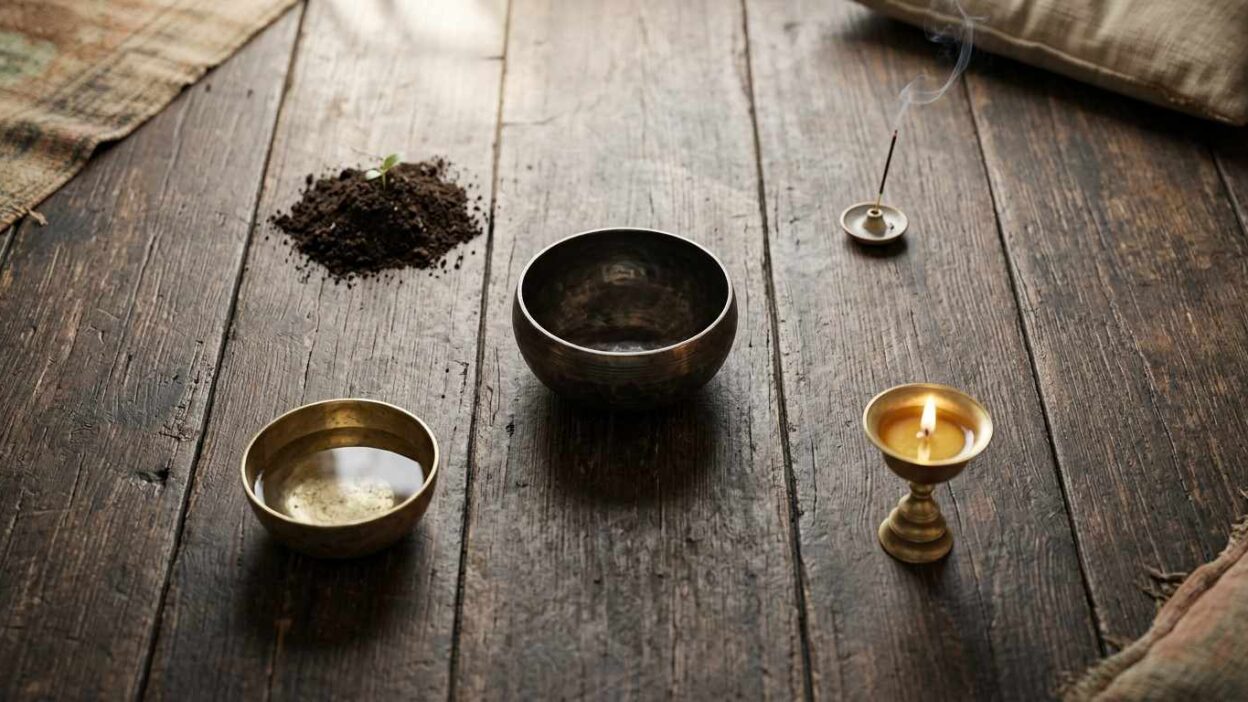
The five elements are earth, water, fire, air and space. In Hindu, yogic and Tibetan Buddhist tradition, they are seen as the building blocks of everything, including the body. Bringing them into daily life means simple habits: grounding on the earth, drinking and bathing mindfully, sitting in morning light, breathing slowly and making time for quiet.
Key takeaways
- In Sanskrit the five elements are called the pancha mahabhuta: prithvi (earth), jala (water), agni (fire), vayu (air) and akasha (space).
- Tibetan Buddhism names the same five: earth, water, fire, wind and space. The Chinese five-element system is a different model.
- The elements are a traditional way of seeing the world, not a scientific model, but they make a useful map for daily habits.
- One small practice for each element, done every day, takes less than 15 minutes.
I am Sunita Poudel, a certified sound healer in Kathmandu, Nepal. Five-element therapy, which my teachers called Panchatatva, was one of the methods I recorded in my training notebook in Patan in 2017. In Nepal the five elements are not an abstract theory. They are part of how many families pray, cook and live. In this guide I explain what the five elements are, how each tradition describes them, and how you can bring them into an ordinary day.

What are the five elements?
The five elements are earth, water, fire, air and space, which ancient Indian philosophy describes as the five great elements (pancha mahabhuta) that make up the physical world and the human body. Each element is linked with a quality and a sense:
- Earth (prithvi): solidity, structure and stability. Linked with the sense of smell.
- Water (jala): flow, cohesion and nourishment. Linked with taste.
- Fire (agni): heat, light and transformation, including digestion. Linked with sight.
- Air (vayu): movement and breath. Linked with touch.
- Space (akasha): openness, the room in which everything exists. Linked with hearing and sound.
The tradition sees space as the subtlest element and earth as the densest, with each element built on the one before it. That is why sound and hearing belong to space, which is a good way to see why sound is at the centre of my practice.
How do different traditions describe the five elements?
Hindu, yogic and Tibetan Buddhist traditions all describe five elements, while Chinese and ancient Greek traditions use different lists. It helps to know the difference, because these systems are often mixed up online.
- Hindu philosophy and yoga: the pancha mahabhuta of earth, water, fire, air and space, as above.
- Ayurveda: India’s traditional medicine groups the elements into three doshas: vata (air and space), pitta (fire and water) and kapha (earth and water). For an overview of Ayurveda’s history and basic principles, see the review by Jaiswal and Williams in the Journal of Traditional and Complementary Medicine.
- Tibetan Buddhism: earth, water, fire, wind and space, which are seen in the body, the mind and the natural world. In the Kathmandu Valley you can see the five element colours in the prayer flags that flutter over every stupa.
- Chinese tradition (wu xing): wood, fire, earth, metal and water. These are described as phases of change rather than substances, so it is a different model.
- Ancient Greek tradition: four elements, earth, water, air and fire, with a fifth, aether, added later.
Do the five elements have a scientific basis?
No. The five elements are a philosophical and spiritual framework, not a scientific description of matter. Modern chemistry describes matter through atoms and the periodic table. I find the elements valuable for a different reason: they help you notice what you need. If you feel scattered, you may need more earth; if you feel heavy and slow, more air or fire.
Some of the habits the elements point to have research behind them. For example, a study of nearly 20,000 adults in England found that people who spent at least two hours a week in nature were more likely to report good health and wellbeing (White et al., Scientific Reports, 2019). The study shows an association, not cause and effect, but it fits the old advice to spend time with earth, water and open sky.
How can you bring the five elements into daily life?
Choose one simple practice for each element and weave them into the day you already have. Here is the gentle routine I suggest:
- Earth, in the morning: stand barefoot on the ground or floor for two minutes. Feel your weight drop through your feet. If you can, touch soil, grass or a plant.
- Water, on waking: drink a glass of plain water slowly, noticing its temperature and taste. Later, let a shower or hand-washing be a moment of attention rather than a rush.
- Fire, at sunrise or midday: sit in natural light for a few minutes, or light a lamp or candle and watch the flame. Eat your main meal when you are calm, since the tradition links fire with digestion.
- Air, at any time: take ten slow breaths by an open window or outdoors. A simple pranayama practice is a good way to work with this element.
- Space, in the evening: sit in silence for five minutes, or listen to one sound until it fades completely. Clear one small surface at home to make physical space too.
If you like to mark time with the moon, these practices also fit into a new moon ritual or a full moon ritual. Find more ideas in our daily rituals section.
From Sunita’s practice
Panchatatva, or five-element therapy, was one of the methods I learned at the Golden Temple Singing Bowl & Healing Center in Patan and wrote down in my training notebook, which later became Dharma Tool’s free course. I treat the elements as a map from tradition. They help me think about balance, pacing and atmosphere in a session. They are not a diagnosis.
Where do you see the five elements in Nepali daily life?
In Nepal the five elements show up in daily worship, in the home and on the streets. In many Hindu homes, the offerings of daily puja are often understood as touching all five: flowers and the earth they grow from, water poured in offering, the flame of the oil lamp, incense carried on the air, and the sound of the bell filling the space. Over the stupas, Tibetan prayer flags carry the five element colours. You do not need to share these beliefs to borrow the idea: make one corner of your home a place where all five are present. Our sacred space at home guides show you how.
How does sound connect with the five elements?
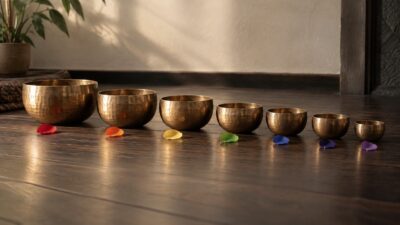
In the tradition, sound is the quality of space, the element that holds all the others, which is why sound is often used to bring the five elements together in one practice. In sound healing, practitioners often play a sequence of bowls such as a 7 bowl chakra set, or put together their own selection with the Dharma Tool set builder. Each element is also traditionally linked with a chakra, which is explained in Dharma Tool’s guide to the 5 element singing bowl set.
New to these ideas? Start with what sound healing is, the 7 chakras and the aura and the subtle body.
A note on wellbeing
The five elements are a traditional framework for reflection and daily habits. They do not diagnose or treat any condition. Barefoot grounding should be done on safe, clean surfaces, and some Ayurvedic products sold online have been found to contain harmful metals, so speak with your doctor before taking any herbal remedy (NCCIH). See our health disclaimer.
Frequently asked questions
What are the five elements?
The five elements are earth, water, fire, air and space. In Hindu, yogic and Tibetan Buddhist tradition they are seen as the building blocks of the physical world and of the human body.
What is pancha mahabhuta?
Pancha mahabhuta is Sanskrit for “the five great elements”: prithvi (earth), jala (water), agni (fire), vayu (air) and akasha (space). The idea is central to yoga philosophy and to Ayurveda.
Are the Chinese five elements the same?
No. The Chinese system, wu xing, names wood, fire, earth, metal and water, and describes them as phases of change. The Indian and Tibetan systems include air and space instead of wood and metal.
Which element is linked to sound?
In Indian tradition, sound is the quality of space (akasha), the subtlest element. This is one reason sound is used in meditation and healing practices to bring a sense of openness.
How can I balance the five elements every day?
Use one simple habit for each: stand barefoot for earth, drink water mindfully, sit in natural light for fire, breathe slowly for air and keep a few minutes of silence for space.
About the author
Sunita Poudel is a certified sound healer in Kathmandu, Nepal. She holds Advanced Sound Healing & Therapy (Golden Temple Singing Bowl & Healing Center, 2017), Advanced Sound Healing, 12 Chakra (Mandala Studio Yoga & Spa, 2018) and Reiki Level 1 (Empowered Academy, 2020) certifications, and has led more than 1,500 sessions.
Sunita co-founded Dharma Tool and selects every instrument it sells. Read her full story →
Sources
- Jaiswal YS, Williams LL. A glimpse of Ayurveda: the forgotten history and principles of Indian traditional medicine. Journal of Traditional and Complementary Medicine, 2017;7(1):50–53. DOAJ.
- White MP, Alcock I, Grellier J, et al. Spending at least 120 minutes a week in nature is associated with good health and wellbeing. Scientific Reports, 2019;9:7730. Nature.
- Ayurvedic Medicine: In Depth. National Center for Complementary and Integrative Health.
This article is for general education and does not replace medical advice. See our health disclaimer.