By Sunita Poudel, certified sound healer and Reiki Level 1 practitioner, Kathmandu · Reviewed by Sunita Poudel on 28 October 2026 · Last updated 28 October 2026
Reiki is a gentle Japanese practice in which a practitioner rests their hands lightly on or just above a fully clothed person to encourage relaxation and a sense of balance. It is based on the traditional idea of a life energy. Many people find it calming, but research has not shown it to treat any health condition.
Key takeaways
- Reiki began in Japan in the early 1900s and is now practised around the world.
- In a session, you lie or sit fully clothed while the practitioner places their hands lightly on or near you.
- Most people describe it as deeply relaxing. It has no known harmful effects.
- Scientific reviews have not found clear evidence that Reiki treats any condition, so it should never replace medical care.
I am Sunita Poudel, a certified sound healer in Kathmandu, Nepal. I completed Reiki Level 1 in 2020, and I use Reiki as a supporting layer of awareness in my sound sessions. In this guide I explain what Reiki is, what happens in a session, what it can feel like, and, honestly, what science does and does not support.

What is Reiki?
Reiki is a hands-on relaxation practice based on the belief that a universal life energy can be gently encouraged to flow through the body to support wellbeing. The word comes from Japanese: “rei” is often translated as universal, and “ki” as life energy, similar to “qi” in Chinese tradition or “prana” in Indian tradition.
Reiki was developed in Japan in the early 20th century and is usually traced to Mikao Usui. Today it is practised worldwide, from wellness centres to some hospitals, where it is offered as a comfort practice alongside, never instead of, medical care.
It is important to be clear: the energy that Reiki describes is a traditional and spiritual idea. There is no scientific evidence for it, as the US National Institutes of Health notes.
How is Reiki practised?
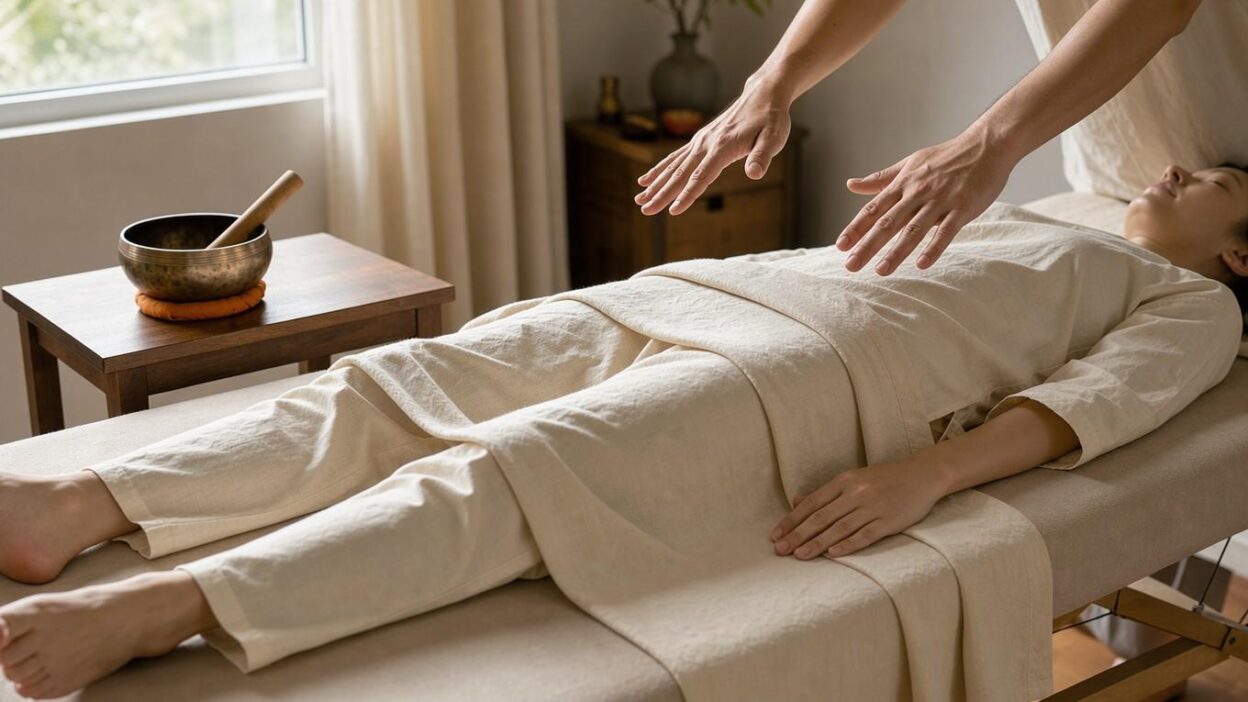
In a Reiki session, the practitioner places their hands lightly on, or just above, a series of areas of the body and holds each position for a few minutes. There is no massage, pressure or manipulation. You stay fully clothed, usually lying on a treatment table or mat.
- Settling: a short conversation, then you lie down and close your eyes.
- Hand positions: the practitioner moves slowly through positions, often from the head towards the feet, resting the hands for a few minutes each.
- Quiet: the session is mostly silent, sometimes with soft music or sound.
- Closing: you rest for a moment, then slowly sit up and drink some water.
A full session usually lasts 45 to 90 minutes. People can also learn simple self-Reiki to practise on themselves at home.
What does Reiki feel like?
Most people describe Reiki as deeply relaxing and peaceful, often with a feeling of warmth under the practitioner’s hands. Some notice tingling, heaviness or lightness. Many drift close to sleep. Others notice emotions surfacing as they relax, or feel very little the first time. All of these experiences are normal.
From Sunita’s practice
I completed Reiki Level 1 with Empowered Academy under Reiki Master Ben Clarke in January 2020. In my work, Reiki is not a separate treatment. It is a layer of awareness that helps me read how a person is responding and pace the session. Sound always stays at the centre of what I do. You can see my Reiki certificate on my About page.
What does the research say about Reiki?
The research on Reiki is limited and mostly low quality, and it has not shown that Reiki treats any health condition.
- The US National Institutes of Health states that Reiki has not been clearly shown to be effective for any health-related purpose, that most studies are low quality with inconsistent results, and that Reiki has not been shown to have harmful effects (NCCIH).
- A Cochrane review of randomised trials found insufficient evidence to say whether Reiki is useful for people with anxiety or depression (Joyce and Herbison, 2015).
My honest view: Reiki can be a calming, caring experience, and many people value it for that. It should be understood as a relaxation and wellbeing practice, not as treatment, and it should never delay seeing a doctor.

What are the levels of Reiki training?
Reiki is usually taught in three levels: Level 1 for self-practice and the basics, Level 2 for practising on others with more techniques, and Level 3, often called Master level, for teaching. The details vary between schools and lineages. I hold Level 1, and I describe my training exactly as my certificate states.
How does Reiki relate to sound healing?
Reiki and sound healing both aim to help a person relax deeply, and they are sometimes used together. Sound works through what you hear and feel as vibration, while Reiki works through gentle touch and stillness. In a combined session, sound can help the body settle, creating a quiet state in which Reiki is easier to receive.
Dharma Tool explains how singing bowls and Reiki can be combined. Reiki with bowls is also covered in the free healing course, based on my own training notebook. To learn more about sound itself, read what sound healing is and what sound massage is.
Who is Reiki for, and who should be careful?
Reiki is gentle and has no known harmful effects, so it suits most people looking for relaxation, but it must never replace medical or mental health care. Keep these points in mind:
- Continue any treatment or medication your doctor has prescribed.
- Tell your practitioner about any health condition, injury or pregnancy, and about any areas you prefer not to be touched.
- You can ask for hands-off Reiki, where the practitioner’s hands stay just above the body.
- If you live with trauma or a serious mental health condition, talk to your care team first.
Choose a practitioner who is open about their training level. You can check how practitioners describe their certificates, as I do on the healer-selected page. See also our health disclaimer.
For gentle ways to work with the body’s energy centres, explore our chakra healing guides. To ask about a session with me, please get in touch.
Frequently asked questions
What is Reiki in simple terms?
Reiki is a gentle Japanese relaxation practice in which a practitioner rests their hands lightly on or just above a clothed person. It is based on the traditional idea of a universal life energy and is mainly used to help people relax.
Does Reiki actually work?
Many people find Reiki relaxing, but scientific reviews have not found clear evidence that it treats any health condition. The US National Institutes of Health notes that most studies are low quality and that Reiki has no known harmful effects.
What does a Reiki session feel like?
Most people feel deeply relaxed, often with warmth under the practitioner’s hands. Some notice tingling, heaviness or emotion, and some feel very little at first. All of these are normal.
Do you have to undress for Reiki?
No. You stay fully clothed throughout a Reiki session, usually lying on a table or mat. Comfortable, loose clothing works best.
Is Reiki safe?
Reiki has not been shown to have harmful effects, so it is considered safe for most people. However, it should never replace or delay medical or mental health care.
About the author
Sunita Poudel is a certified sound healer in Kathmandu, Nepal. She holds Advanced Sound Healing & Therapy (Golden Temple Singing Bowl & Healing Center, 2017), Advanced Sound Healing, 12 Chakra (Mandala Studio Yoga & Spa, 2018) and Reiki Level 1 (Empowered Academy, 2020) certifications, and has led more than 1,500 sessions.
Sunita co-founded Dharma Tool and selects every instrument it sells. Read her full story →
Sources
- Reiki. National Center for Complementary and Integrative Health, US National Institutes of Health.
- Joyce J, Herbison GP. Reiki for depression and anxiety. Cochrane Database of Systematic Reviews, 2015. Cochrane.
This article is for general education and does not replace medical or mental health advice. See our health disclaimer.