By Sunita Poudel, certified sound healer, Kathmandu · Reviewed by Sunita Poudel on 23 October 2026 · Last updated 23 October 2026
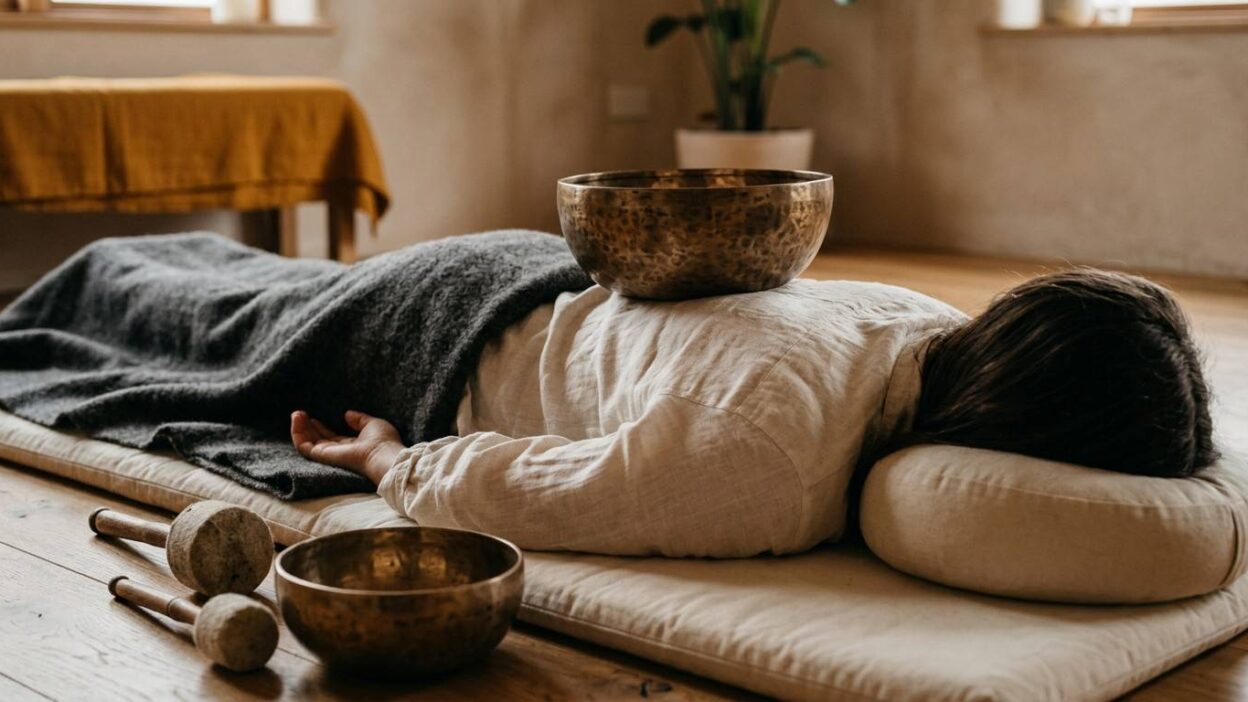
Sound massage is a relaxation practice in which singing bowls are placed on or near the clothed body and gently struck, so their vibration is felt as well as heard. It is not a muscle massage: nothing presses or rubs the body. Most people use it to relax deeply, settle the mind and become more aware of the body.
Key takeaways
- In sound massage, you feel the bowl’s vibration through the body, not just through the ears.
- You stay fully clothed, lying or sitting, and the bowls are struck softly.
- A small 2022 study found most participants felt more relaxed and balanced afterwards, but larger trials are still needed.
- It is not suitable for everyone: pregnancy, pacemakers, epilepsy and recent surgery all need a doctor’s advice first.
I am Sunita Poudel, a certified sound healer in Kathmandu, Nepal. Sound massage was one of the methods I trained in at Patan in 2017, and it is part of my practice today. In this guide I explain what sound massage is, how it works, what research says so far, and who should take extra care.

What is sound massage?
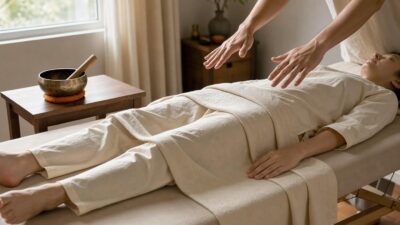
Sound massage is a gentle form of sound healing that uses the physical vibration of singing bowls, felt through the body, to help a person relax. A practitioner places a bowl on the clothed body, or holds it just above, and strikes it softly. The vibration spreads through the body while the tone fills the room.
Despite the name, it is very different from a traditional massage. There is no pressure, rubbing or oil. The “massage” is the vibration itself. In the West, the modern method is often credited to the German practitioner Peter Hess, who developed his approach in the 1980s, but the use of bowls close to the body is part of a wider Himalayan sound tradition.
Sound massage is one of several ways to experience sound. For the bigger picture, read what sound healing is.
How does sound massage work?
Sound massage works through two channels at once: you hear the tone, and you feel its vibration in the body.
- Feeling the vibration. When a bowl rests on the body and is struck, its vibration travels into the area beneath it. Many people describe a gentle tingling, warmth or a wave-like movement.
- Hearing the tone. The long, fading sound gives the mind a simple focus, much like meditation. I explain this in more detail in how sound affects the brain.
- Slowing down. Lying still while sound and vibration come and go invites the breath to slow and the body to let go. Researchers call this shift the relaxation response, which the US National Institutes of Health describes as a slowing of heart rate and breathing.
What happens during a sound massage?
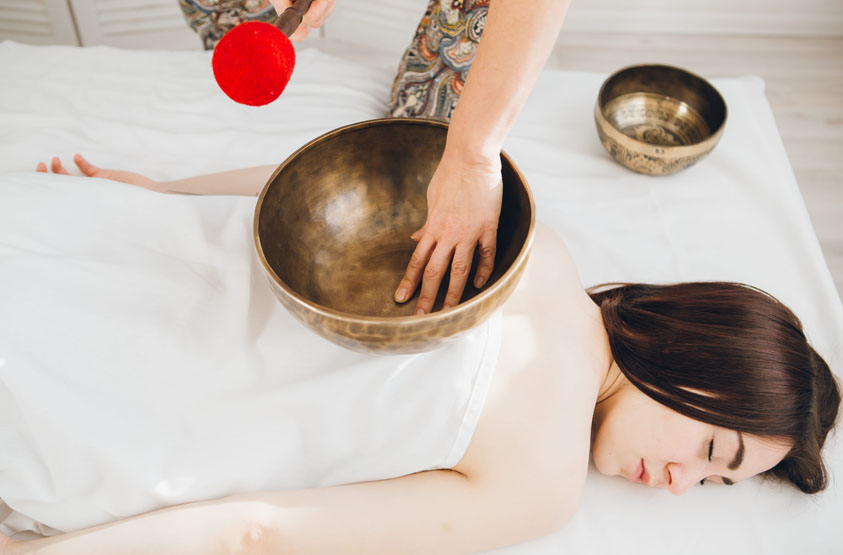
A sound massage usually lasts 30 to 60 minutes: you lie fully clothed on a mat or table while the practitioner places and plays bowls on or around your body. A typical session moves through these stages:
- A short conversation about how you are feeling and anything the practitioner should know about your health.
- Settling, lying on your back or front with blankets for warmth.
- Playing, as bowls are placed and struck gently, one area at a time, with pauses for the vibration to fade.
- Resting quietly at the end, before slowly sitting up.
Bowls are never placed on the head, the face, or any area that is injured or sensitive. Where they are placed depends on the method and on you.
From Sunita’s practice
Sound massage is recorded in the handwritten notebook I kept during my training in Patan, alongside the seven chakras, the two playing directions and gentler methods for elderly clients. In every session I play the bowls live, and I choose each one for the person in front of me. A bowl that feels right on one person’s back can feel too strong for another, so I always watch and adjust.
What does sound massage feel like?
Most people describe sound massage as deeply relaxing, with a soft tingling or wave-like vibration where the bowl rests. Some feel warmth, some feel heavy and sleepy, and some notice the vibration travelling further through the body than expected. It is common to drift close to sleep. Occasionally, emotions surface as the body relaxes. All of these are normal.
What does research say about sound massage?
Research is promising but very early: one small study found measurable relaxation and strong self-reported benefits after a singing bowl massage, but it had no control group.
- In a 2022 study of 34 healthy adults, brain activity measured by EEG decreased during and after a singing bowl massage, and most participants reported feeling more relaxed (91%) and more balanced (97%) (Walter and Hinterberger, 2022). The authors note that randomised controlled trials are needed before any clinical conclusions can be drawn.
- A broader 2020 review of singing bowl research found too few high-quality studies to recommend singing bowls as a therapy, while noting that early results justify more research (Stanhope and Weinstein, 2020).
My honest view: sound massage is a gentle, pleasant way to relax and reconnect with the body. It is not a treatment for pain or any medical condition.
Who should be careful with sound massage?
Because bowls are placed on the body, sound massage needs more care than listening practices. Speak with your doctor before a sound massage if you:
- are pregnant
- have a pacemaker or another implanted electronic or metal device
- have epilepsy or a seizure disorder
- have had recent surgery, or have a blood clot, open wounds or inflammation
- have tinnitus or sensitivity to sound
- live with a serious mental health condition or trauma
Always tell your practitioner about any health condition before the session, and ask them to stop if anything feels uncomfortable. Read our health disclaimer.
Can you do sound massage at home?
Yes, in a simple and gentle way: hold a small bowl in your palm, strike it softly, and feel the vibration travel into your hand and arm. This is the safest way to start. Placing bowls on the body is best learned with a trained practitioner first.
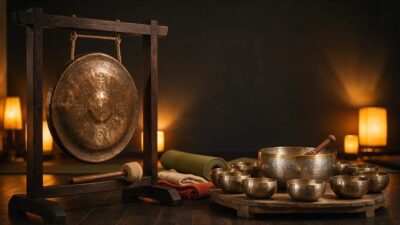
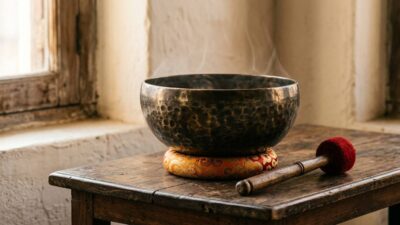
For a bowl that vibrates well in the hand, choose a bowl hammered by hand in Nepal. Hand-hammered bowls tend to have rich, long-lasting vibration. Practitioners often use large standing singing bowls for deeper vibration on the back. If you work as a massage or bodywork therapist, Dharma Tool explains how bowls can be added to massage sessions.

Sound massage pairs well with other gentle practices. You may also enjoy a sound bath, our Reiki and sound guides, or practices for stress and the nervous system. To ask about a session with me, please get in touch.
Frequently asked questions
Is sound massage a real massage?
Not in the usual sense. There is no pressure or rubbing. Singing bowls are placed on or near the clothed body and struck gently, so the “massage” is the vibration you feel.
Do you stay clothed during a sound massage?
Yes. You stay fully clothed, usually lying on a mat or table with blankets for warmth. Comfortable, loose clothing works best.
How long does a sound massage last?
Most sound massage sessions last between 30 and 60 minutes, including a short conversation at the start and quiet rest at the end.
What are the benefits of sound massage?
People most often report deep relaxation, a calmer mind and a stronger sense of their body. Early research supports these relaxation effects, but studies are small and sound massage is not a treatment for any condition.
Who should not have a sound massage?
Speak with your doctor first if you are pregnant, have a pacemaker or implant, epilepsy, recent surgery, a blood clot, open wounds, tinnitus or a serious mental health condition.
About the author
Sunita Poudel is a certified sound healer in Kathmandu, Nepal. She holds Advanced Sound Healing & Therapy (Golden Temple Singing Bowl & Healing Center, 2017), Advanced Sound Healing, 12 Chakra (Mandala Studio Yoga & Spa, 2018) and Reiki Level 1 (Empowered Academy, 2020) certifications, and has led more than 1,500 sessions.
Sunita co-founded Dharma Tool and selects every instrument it sells. Read her full story →
Sources
- Walter N, Hinterberger T. Neurophysiological Effects of a Singing Bowl Massage. Medicina, 2022. PubMed Central, US National Library of Medicine.
- Stanhope J, Weinstein P. The human health effects of singing bowls: a systematic review. Complementary Therapies in Medicine, 2020 (University of Adelaide repository).
- National Center for Complementary and Integrative Health. 5 Things To Know About Relaxation Techniques for Stress. NCCIH, US National Institutes of Health.
This article is for general education and does not replace medical advice. See our health disclaimer.