By Sunita Poudel, certified sound healer, Kathmandu · Reviewed by Sunita Poudel on 16 October 2026 · Last updated 16 October 2026
A sound bath is a guided relaxation session in which you lie down, fully clothed, while a practitioner plays instruments such as singing bowls, gongs and chimes around you. No water is involved: you are bathed in sound. Most people use it to rest deeply, quiet a busy mind and ease everyday stress.
Key takeaways
- A sound bath is usually a group session lasting 45 to 90 minutes. You rest while the sound washes over you.
- Your only job is to listen. There is nothing to learn and no right way to feel.
- Early studies suggest sound meditation can help people feel more relaxed and less tense, but the research is still small.
- If you are pregnant, have epilepsy, an implanted device or sensitivity to sound, check with your doctor first.
I am Sunita Poudel, a certified sound healer in Kathmandu, Nepal. I lead sound baths for individuals, yoga studios, wellness centres and corporate groups, always with live instruments. In this guide I explain what a sound bath is, how it differs from a one-to-one session, what it can feel like, and what the research honestly says.

What is a sound bath?
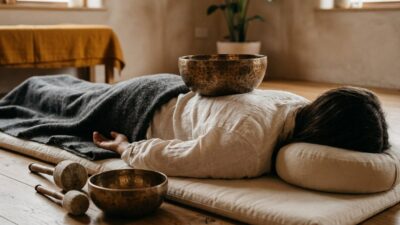
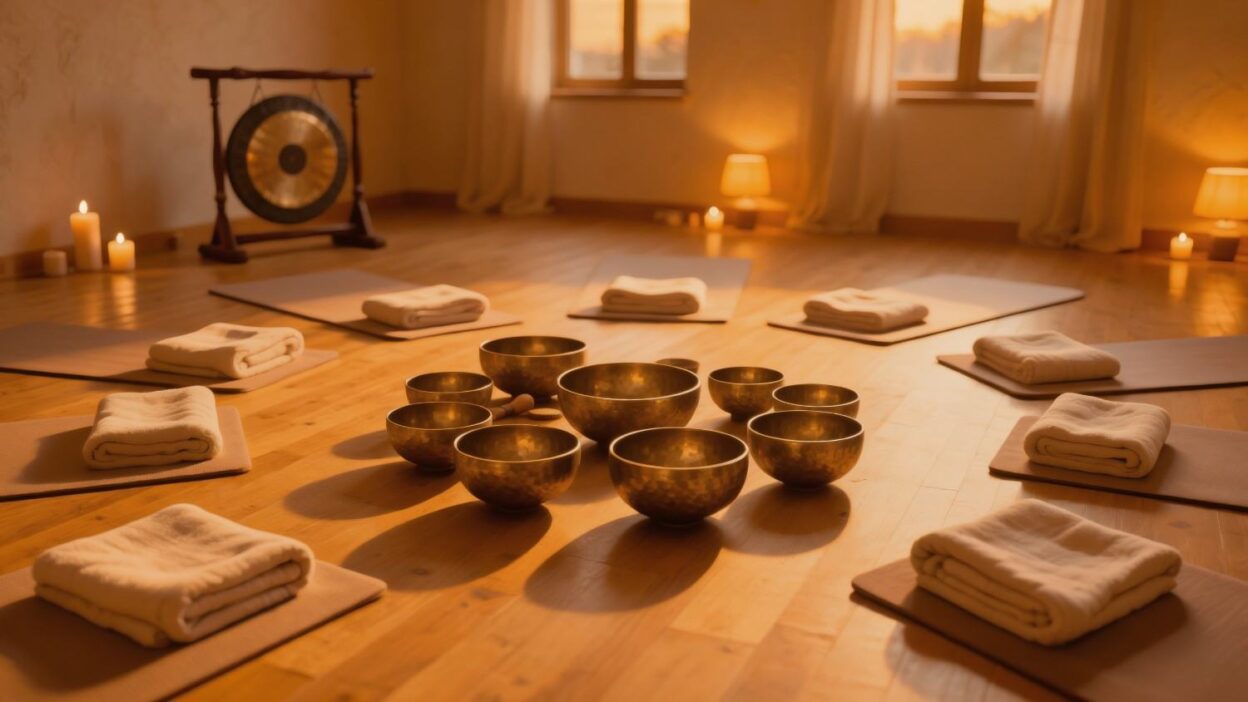
A sound bath is a meditative experience in which a group of people lie still and listen while instruments are played around them. The word “bath” describes how the sound feels: it surrounds you from every side, the way water does, and you simply soak in it.
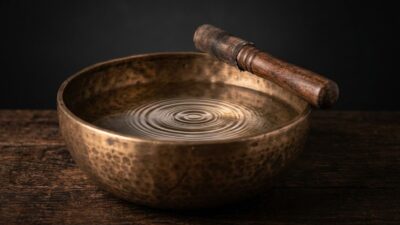
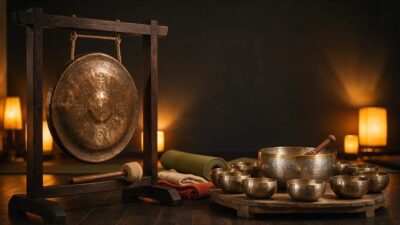
The instruments are chosen for their long, rich tones. Himalayan singing bowls are the heart of most sound baths, often joined by gongs, tingsha, chimes and sometimes the voice. Because the sound is played live, it moves around the room and changes from moment to moment.
Sound baths are one form of sound healing, which I explain in my main guide.
Is a sound bath the same as sound healing?
A sound bath is a type of sound healing, usually for a group, while a sound healing session is usually one-to-one and more personal.
| Sound bath | One-to-one sound healing | |
|---|---|---|
| Group size | Usually a group | One person |
| Instruments | Played around the room | Played close to the person, sometimes near the body |
| Focus | Shared rest and relaxation | Tailored to one person’s intention |
| Typical length | 45 to 90 minutes | 30 to 60 minutes |
How does a sound bath work?
A sound bath works mainly by giving your attention something slow and steady to rest on, which helps the body shift into a calmer state. Long, fading tones invite the breath to slow down. Listening closely to them works like a meditation that needs no effort or experience. You can read more about this in our sound therapy and brainwaves section.
This calmer state is what researchers call the relaxation response, in which heart rate and breathing slow down. The US National Institutes of Health describes it clearly in its guide to relaxation techniques for stress.

How the bowls are arranged shapes how the sound reaches the group. A circle surrounds everyone evenly, while a semi-circle keeps the practitioner close to every bowl. Dharma Tool shows five ways practitioners arrange the bowls, with photos of each.
What does a sound bath feel like?
Most people feel deeply relaxed during a sound bath, often heavier and calmer, but every experience is different. You may notice your breathing slow, feel gentle vibration in your body, drift close to sleep, see colours with your eyes closed, or feel emotion rise to the surface. Some people feel very little the first time and more on later visits.
From Sunita’s practice
In a group sound bath, just as in one-to-one work, I see that every person responds in their own way. I never ask a group to feel the same thing. Whatever comes up for you, whether that is rest, emotion or simply quiet, is the right response for you on that day.
What are the benefits of a sound bath? What the research says
Small studies suggest that sound meditation can reduce tension and improve mood, but the evidence is still early and does not support treating any condition.
- In a 2017 study of 62 adults, participants reported less tension, anger, fatigue and depressed mood after a singing bowl sound meditation (Goldsby et al., 2017). The study had no control group.
- In a 2019 randomised trial with 74 university students, a 30-minute live sound meditation led to greater relaxation and stress reduction than silent meditation (Philips et al., 2019). The instrument used was a didgeridoo, not singing bowls, so the results may not carry over exactly.
- Relaxation practices in general are considered safe for most healthy people, but they should never replace or delay medical care (US National Institutes of Health).
My honest view: a sound bath is a wonderful way to rest and reset, especially if sitting still in silent meditation feels hard. It is not a treatment, and it works best as one part of a calm, healthy routine.
How long is a sound bath?
Most sound baths last 45 to 90 minutes, including time to settle in at the start and rest quietly at the end. The sound itself usually lasts 30 to 60 minutes. Shorter sessions of 20 to 30 minutes are common in yoga classes, often at the end during savasana and yoga nidra.
Who is a sound bath for, and who should be careful?
A sound bath suits most adults who want to relax, and it needs no experience. A few people should speak with a doctor first. Please check with your doctor before joining if you:
- are pregnant
- have epilepsy or a seizure disorder
- have a pacemaker or another implanted device
- have tinnitus, hearing difficulties or sensitivity to sound
- live with a serious mental health condition or trauma
You can always move, sit up or leave the room if anything feels uncomfortable. Read our health disclaimer for more.
Can you have a sound bath at home?
Yes. You can create a simple sound bath at home with a few bowls, a mat and a quiet room. Lie down, ask a friend or family member to play gently, or play a single bowl yourself while sitting, and listen until each tone fades completely. For sleep-friendly evening practices, see our sleep guides.
Many practitioners use a chakra singing bowl set so the notes sound well together. If you would like to choose your own notes and sizes, you can build your own set.

If you teach yoga or want to guide others, our leading a sound bath section is written for you. To ask about a sound bath for your studio or team, please contact me.
Frequently asked questions
Do you get wet in a sound bath?
No. A sound bath involves no water at all. You lie down fully clothed, and the “bath” describes how the sound surrounds you from every side.
What should I wear to a sound bath?
Wear loose, comfortable clothes and warm socks. Bring a blanket and a small pillow if the venue does not provide them, because the body cools down as it relaxes.
Is it okay to fall asleep during a sound bath?
Yes. Many people drift close to sleep or fall asleep. It is a natural sign that the body is resting, and you can still benefit from the session.
How often should you do a sound bath?
There is no fixed rule. Many people enjoy a sound bath once a week or once a month. Notice how you feel afterwards and choose a rhythm that suits you.
Is a sound bath safe for everyone?
Sound baths are gentle and suit most adults, but speak with your doctor first if you are pregnant, have epilepsy, an implanted device, tinnitus or a serious mental health condition. A sound bath does not replace medical care.
About the author
Sunita Poudel is a certified sound healer in Kathmandu, Nepal. She holds Advanced Sound Healing & Therapy (Golden Temple Singing Bowl & Healing Center, 2017), Advanced Sound Healing, 12 Chakra (Mandala Studio Yoga & Spa, 2018) and Reiki Level 1 (Empowered Academy, 2020) certifications, and has led more than 1,500 sessions.
Sunita co-founded Dharma Tool and selects every instrument it sells. Read her full story →
Sources
- Goldsby TL, Goldsby ME, McWalters M, Mills PJ. Effects of Singing Bowl Sound Meditation on Mood, Tension, and Well-being: An Observational Study. Journal of Evidence-Based Complementary & Alternative Medicine, 2017.
- Philips KH, Brintz CE, Moss K, Gaylord SA. Didgeridoo Sound Meditation for Stress Reduction and Mood Enhancement in Undergraduates: A Randomized Controlled Trial. Global Advances in Health and Medicine, 2019.
- National Center for Complementary and Integrative Health. 5 Things To Know About Relaxation Techniques for Stress. NCCIH, US National Institutes of Health.
This article is for general education and does not replace medical advice. See our health disclaimer.