By Sunita Poudel, certified sound healer, Kathmandu · Reviewed by Sunita Poudel on 19 October 2026 · Last updated 19 October 2026
A full moon meditation is a short, quiet practice done on or near the full moon to calm the mind and reflect on the month. A simple version takes 15 minutes: sit comfortably, slow your breathing, rest your attention on the moon, your breath or a fading sound, and close by setting one gentle intention.
Key takeaways
- Time: 15 minutes, on the evening of the full moon or a day either side.
- Focus: the moon, your breath, or the sound of a singing bowl.
- No experience needed: if your mind wanders, gently come back. That is the practice.
- You do not need to see the moon. Cloudy nights and indoor practice work just as well.
I am Sunita Poudel, a certified sound healer in Kathmandu, Nepal. The full moon is one of the easiest times to begin a meditation habit, because it gives you a clear, beautiful reminder once a month. Below is the simple 15-minute guided practice I recommend for beginners, with a version that uses a singing bowl.

What is a full moon meditation?
A full moon meditation is any meditation practised on or around the full moon, usually with the moon as a gentle point of focus. It can be as simple as sitting quietly by a window and watching your breath, or as structured as a guided practice with sound and intention.
It is different from a full moon ritual. A ritual often includes writing and letting go, while a meditation is mainly about stillness and attention. Many people do both on the same evening: first the meditation to settle, then the full moon ritual for reflection and release.
Why meditate at the full moon?
The full moon gives you a natural, monthly reminder to pause, and it carries a long tradition of meditation in Buddhist and Hindu life. In Nepal, full moon days, called Purnima, are traditionally days for prayer, visiting temples and monasteries, and meditation. Many Buddhists keep extra practice on full moon and new moon days.
You do not need to share these beliefs to benefit. The practical value is simple: a habit linked to a regular event is easier to keep.
What does research say about meditation?
Research suggests that regular meditation may help with stress, anxiety and low mood, although the effects are modest and depend on regular practice. A large review of 47 trials found that mindfulness meditation programmes showed moderate evidence of improving anxiety, depression and pain (Goyal et al., 2014). The US National Institutes of Health notes that meditation is generally safe for healthy people, but that it can occasionally bring up difficult feelings, and that it should not replace medical care (US National Institutes of Health).
There is no scientific evidence that meditation is more powerful at the full moon. Its value here is as a meaningful, regular reminder.
How do you prepare for a full moon meditation?
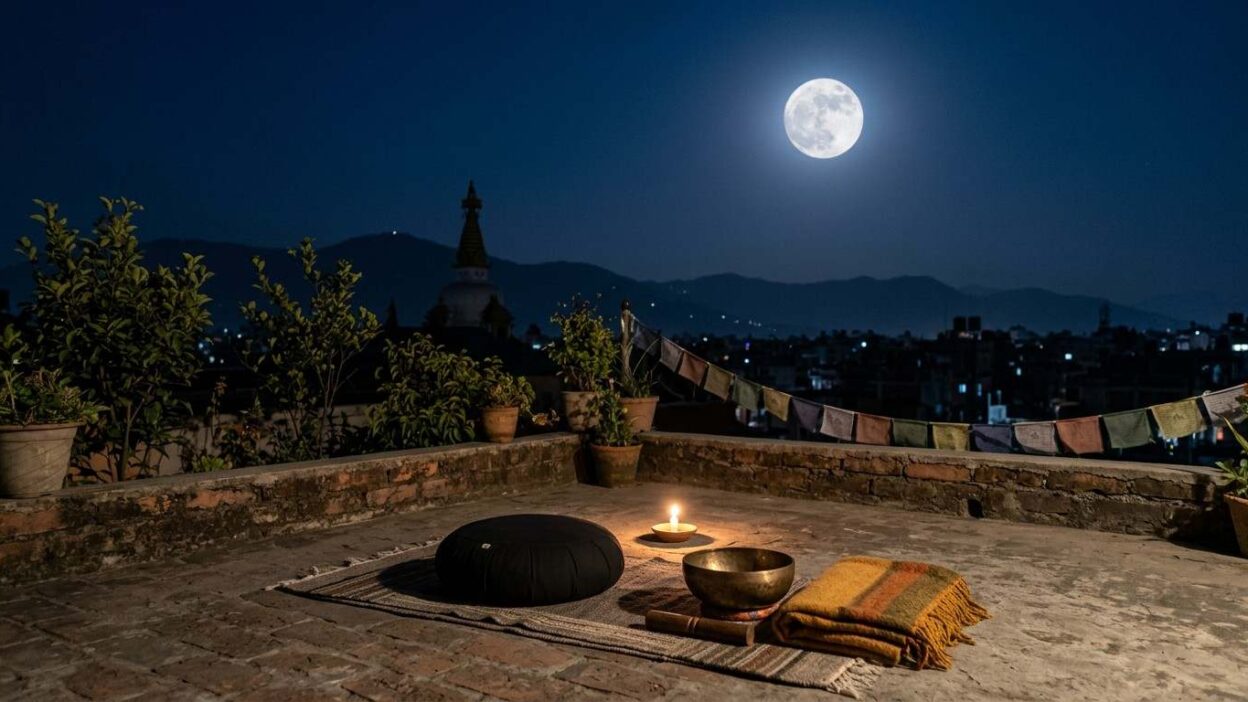
Find a quiet spot, ideally where you can see the moon, and make sure you will not be disturbed for 15 minutes.
- Sit on a cushion, a chair or the edge of your bed. Your back should be comfortable and upright.
- Turn off bright lights. Moonlight, a candle or a soft lamp is enough.
- Put your phone on silent and set a gentle 15-minute timer.
- Wear something warm. The body cools as it relaxes, especially outdoors.
A 15-minute guided full moon meditation
Read through the steps once, then follow them slowly. The timings are a guide, not a rule.
- Arrive (2 minutes). Sit comfortably and look at the moon, or imagine it if you cannot see it. Notice its light, its shape and the space around it. Let your shoulders drop.
- Slow the breath (3 minutes). Breathe in gently through the nose for a count of four, and out for a count of six. Let each out-breath be a little longer than the in-breath. For more breathing practices, see our pranayama guides.
- Rest your attention (6 minutes). Close your eyes and choose one anchor: the feeling of the breath, the memory of the moon’s light, or a fading sound. When your mind wanders, and it will, simply notice and return. Each return is the practice.
- Notice the month (2 minutes). Without judging, let the past month pass through your mind like clouds across the moon. Notice what you feel.
- Set one intention (2 minutes). Silently choose one simple word or phrase to carry into the next month, such as “patience”, “rest” or “kindness”. Take three slow breaths, open your eyes and sit for a moment before you get up.
How do you use a singing bowl in a full moon meditation?
A singing bowl gives the mind a clear, steady sound to follow, which many beginners find easier than following the breath. Use it at three moments:
- To begin: strike the bowl once and listen until the sound fades completely.
- During step 3: strike it every minute or so and rest your attention on the tone until it disappears.
- To close: strike it once more as you set your intention.
If sound practice is new to you, my guides to what sound healing is and singing bowl meditation explain more.

For moon practice, some people choose bowls made for full moon practice, traditionally hand-hammered in Nepal on full moon nights. Dharma Tool explains what makes these bowls special and how they are made. If you prefer a bowl chosen for everyday practice, see the meditation singing bowl collection.
Can you meditate on a full moon without seeing the moon?
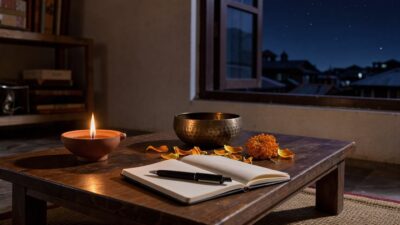
Yes. The moon is a helpful focus, but it is not required. On a cloudy night, or if you practise indoors, imagine the full moon in your mind, or use your breath or a singing bowl as your anchor. The intention of pausing once a month is what matters most.
Tips for beginners
- Start shorter if you need to. Five quiet minutes is better than none.
- Expect a busy mind. Wandering thoughts are normal, even for experienced meditators.
- Practise early in the evening. Sleep can be lighter around the full moon, so finish before bedtime. See our sleep guides for gentle wind-down practices.
- Try a mantra. Repeating a simple word or sound can steady attention. Our mantra meditation section shows how.
- Keep a monthly note. Write your intention down. By the next full moon, you can look back and notice what changed.
A gentle note on safety
Meditation is safe for most people, but it can sometimes bring up strong emotions or memories. If this happens, open your eyes, feel your feet on the floor and return to normal breathing. If you live with trauma, a serious mental health condition, or feel distressed, please speak with a qualified professional before meditating alone. See our health disclaimer.
Frequently asked questions
How do you meditate on a full moon?
Sit comfortably where you can see the moon, slow your breathing, and rest your attention on the moon, your breath or a fading sound for about 15 minutes. Finish by silently setting one simple intention for the month ahead.
How long should a full moon meditation be?
Fifteen minutes is a good length for beginners. If that feels too long, start with five minutes and build up over a few months.
Do I need to be outside or see the moon?
No. You can meditate indoors or on a cloudy night by imagining the moon or using your breath or a singing bowl as your focus.
What is the difference between a full moon meditation and a full moon ritual?
A full moon meditation focuses on stillness and attention. A full moon ritual usually adds writing, reflection and letting go. Many people meditate first and then do the ritual on the same evening.
Can I use a singing bowl in a full moon meditation?
Yes. Strike the bowl to begin, every minute or so during the meditation, and again at the end. Listening to the tone until it fades helps the mind settle.
About the author
Sunita Poudel is a certified sound healer in Kathmandu, Nepal. She holds Advanced Sound Healing & Therapy (Golden Temple Singing Bowl & Healing Center, 2017), Advanced Sound Healing, 12 Chakra (Mandala Studio Yoga & Spa, 2018) and Reiki Level 1 (Empowered Academy, 2020) certifications, and has led more than 1,500 sessions.
Sunita co-founded Dharma Tool and selects every instrument it sells. Read her full story →
Sources
- Goyal M, Singh S, Sibinga EMS, et al. Meditation programs for psychological stress and well-being: a systematic review and meta-analysis. JAMA Internal Medicine, 2014. PubMed.
- National Center for Complementary and Integrative Health. Meditation and Mindfulness: Effectiveness and Safety. NCCIH, US National Institutes of Health.
This article is for general education and does not replace medical or mental health advice. See our health disclaimer.